
-

Envie-nos um e-mail
sale@lscmagnetics.com -

Número de contato
+86 -13559234186
Envie-nos um e-mail
sale@lscmagnetics.comNúmero de contato
+86 -13559234186

How Do Wire Rope Ring Boxes Work in Precast Concrete Connections?
Nov 05, 2026Wire rope ring boxes are key embedded components that transfer shear force and create structural connections between precast concrete wall panels. The principle is simple: before pouring at the factory, the box is nailed to the formwork, concealing the wire rope loop inside. On site, the tape is removed, the loop is pulled out, transverse reinforcing steel is inserted, and the joint concrete is poured—firmly "locking" the two precast wall panels together.
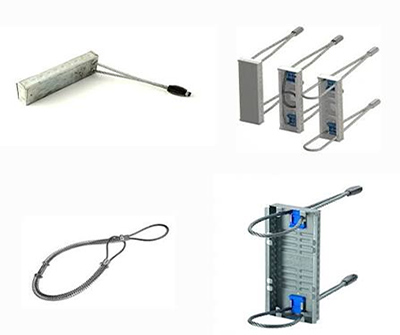
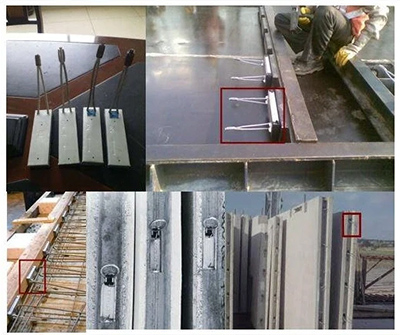
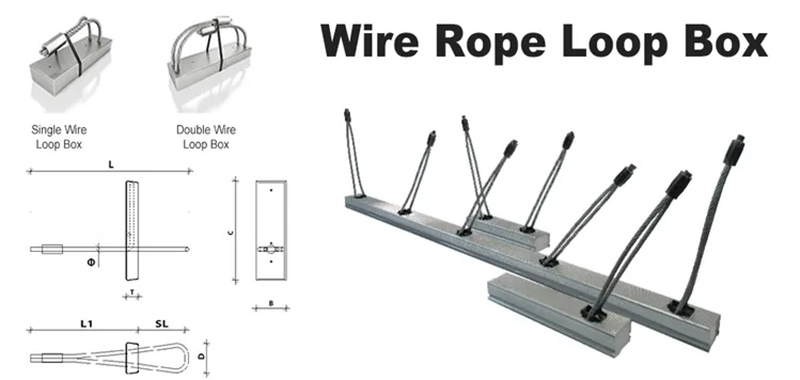
A wire rope ring box consists of a galvanized steel box and a high-strength wire rope loop. The steel box protects the loop from cement slurry contamination during pouring and confines it within the box so it does not protrude from the concrete surface. The loop itself is typically made of high-strength galvanized steel wire rope about 6.0 mm in diameter, formed into a loop by crimping.
The prefabrication process at the plant is straightforward: nail or glue the ring boxes to the formwork at the designed spacing, with the box opening flush with the formwork surface; pour and cure the concrete; after demolding, the box opening is exposed on the joint face of the precast wall panel, while the loop remains hidden inside the box, protected by anti-fouling tape or a cover.
Once the precast wall panels arrive on site, the actual connection work begins:
Step 1: Expose the loops. Peel off the anti-fouling tape at the box opening and use a hammer or pry bar to pry the wire rope loops out of the box so they are perpendicular to the panel end face. Some well-designed products spring the loops automatically into the target position once pried out, eliminating manual adjustment.
Step 2: Lift and position. Lift the wall panel into place so that the loops of adjacent panels interlace at the joint. At this stage the loops are flexible and will not collide or jam during lifting the way rigid rebar would.
Step 3: Insert the horizontal reinforcing bar. A horizontal reinforcing bar (crossbar) is inserted through the loops extending from the two wall panels. This bar acts as the "bridge" for force transmission—shear force from one panel passes through its loops to the crossbar and then to the loops of the adjacent panel.
Step 4: Pour the joint. After the formwork is erected, concrete (or grout) is poured into the joint, encasing the loops and crossbar. Once it hardens, the two precast wall panels act as a single whole through this "wire rope—crossbar—wire rope" load path.
The primary design function of the wire rope loop box is to transmit shear force—that is, to prevent relative in-plane displacement between adjacent wall panels. At the same time, certified product systems can also resist a certain amount of tensile force and accommodate combined shear and tension. For load-bearing precast wall panel systems, this connection is a critical element of structural safety.
In terms of product parameters, common single-loop boxes have a minimum breaking load on the order of 24 kN, and loop effective lengths range from 60 mm to 140 mm, accommodating wall panel joints of different widths.
Flexibility is the biggest advantage. Rigid embedded rebar or steel plates tend to interfere with formwork, reinforcement, or adjacent components during hoisting. Wire rope loops, by contrast, can be bent or concealed inside the box during transport and hoisting and then unfolded after placement. This "stowed away when not in use, pulled out when needed" characteristic protects the connector itself and simplifies on-site hoisting.
In addition, the flexibility of wire ropes allows a certain tolerance at the joint during construction, unlike rigid connections, which demand millimeter-level positioning accuracy for the wall panels.
| Scenario | Connection Method | Features |
| Vertical joint of precast shear walls | Rope ring boxes are embedded in the edges of both panels, interlocked and grouted after erection | Replaces sleeve grouting; high tolerance for error |
| Cavity connection of composite shear walls | Loops extend from both panels, interlock inside the cavity, then concrete is poured | Shares load with the composite layer |
| Wall panel to foundation/floor slab connection | Vertical loops are embedded in the lower component and interlock with the horizontal loops of the upper component | Connects construction layers |
| Joint of non-load-bearing exterior wall panels | Transmits only self-weight and wind load; loops serve as safety ties | Simple construction |
Advantages over traditional connection methods:
High tolerance for error: Compared with sleeve grouting, which requires precise alignment (±3 mm), rope-loop interlocking tolerates greater installation deviation.
Fast construction: No hole alignment or separate grouting sleeves are needed; grouting can begin immediately after the panel is erected.
Outstanding shear resistance: Ring interlocking transfers shear force efficiently at vertical joints.
Compatible with composite construction: Integrally formed with the concrete subsequently poured in the cavity.
Common quality defects and countermeasures:
| Problem | Cause | Countermeasure |
| Loop cannot be pulled out on site | Grout or rust inside the box | Seal the protective cover during production; randomly check loop opening before shipment |
| Loops cannot interlock | Excessive spacing or misalignment of loops on the two sides | Strictly control embedding positioning accuracy; conduct a trial placement before hoisting |
| Inadequate grouting | Narrow joint; no venting | Joint width ≥ design requirement; grout from low to high and observe venting |
| Edge concrete splitting | Missing reinforcement; insufficient edge distance | Install edge mesh per drawings; verify product edge-distance requirements |
| Supports removed before strength is reached | Insufficient curing time | Control support removal time using test blocks cured under the same conditions |
The essence of the wire rope ring box is a combined mechanism of "flexible interlocking + rigid filling" that turns joints between precast components into a reliable, force-transmitting whole. It lowers the precision threshold for precast installation and is particularly suited to vertical shear connections and overlapping systems. For component manufacturers, the key lies in embedding accuracy and box protection; for contractors, it lies in proper interlocking and dense grouting. With these two aspects well controlled, the connection performance of the wire rope ring box can be fully realized.
Whatsapp : +86 -13559234186
E-mail : sale@lscmagnetics.com
Telefone : +86 -13559234186